

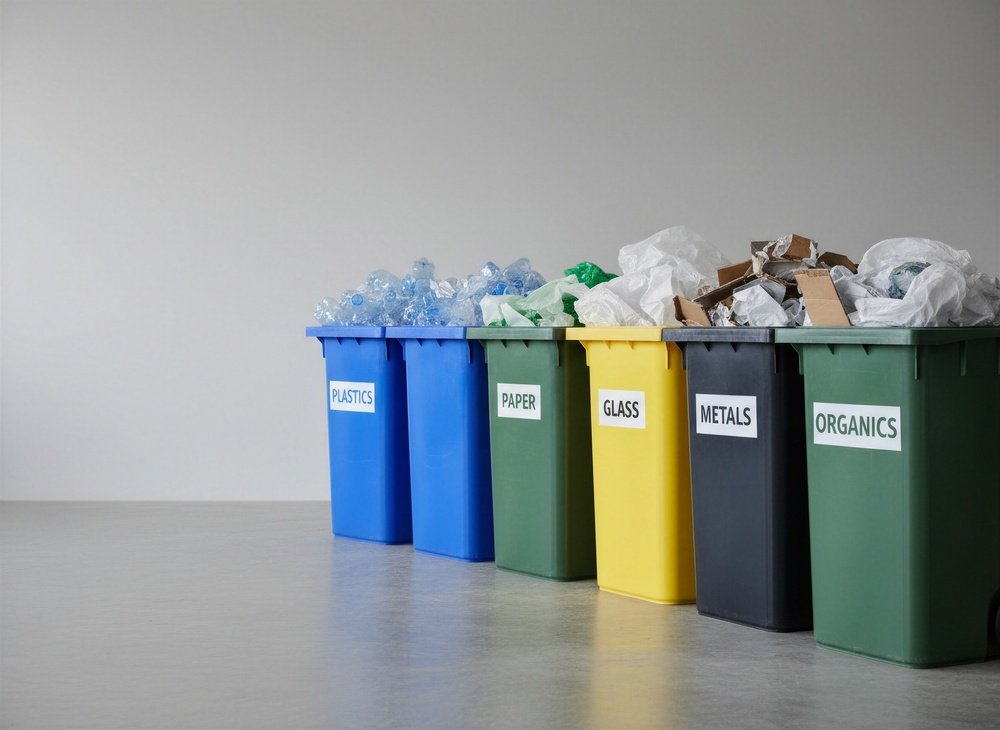
Summary: Daily janitorial work is about keeping spaces clean and tidy. In Boston, however, it is also about complying with recycling mandates. Both Boston and Massachusetts take recycling seriously. They expect businesses to comply.
‘Going green’ in Boston is not just a slogan for corporate social responsibility; it is a requirement. Local leaders have implemented an ambitious Zero Waste Boston program with the goal of diverting as much as 80% of the city’s waste from landfills over the next decade. Businesses throughout Boston are expected to get on board.
From the perspective of property owners and facility managers, maintaining compliance with the Massachusetts Department of Environmental Protection (MassDEP) waste bans and the Boston Commercial Recycling Ordinance is mandatory. Moreover, compliance is no longer a ‘set it and forget it’ scenario. It requires an active effort of cooperation among high-level decision-makers, team leaders, and the janitorial staff.
The risk of noncompliance is not worth it. Consider the fact that some fines for breaking the rules can be as high as $200 per day. It is far better and more cost-effective to establish compliant recycling practices implemented daily.
Local and State Mandates
The first thing every Boston business owner should know about commercial recycling is that it is regulated at both the local and state levels. Therefore, business and property owners are looking at a two-tiered system. At the state level, 310 CMR 19.017 defines the regulatory framework.
Massachusetts Waste Disposal Bans
The state of Massachusetts prohibits the disposal of a long list of materials in the trash. Throughout Boston, we talk about these materials in terms of waste bans. The bans specifically require that items be diverted for recycling or reuse. There are basically four categories:
- Paper and Cardboard – All forms of recyclable paper, folders, and corrugated cardboard.
- Glass, Metal, and Plastic Containers – This includes bottles, cans, jars, and jugs.
- Textiles and Mattresses – Both textiles and mattresses require specialized disposal through recyclers.
- Organic/food Waste – Commercial entities generating more than half-a-ton of organic waste weekly (including food) must compost it or send it to an anaerobic digestion facility.
For your typical Boston office, the big concerns are paper and cardboard, along with glass, metal, and plastic containers. Organic and food waste applies mainly to landscapers and food service providers.
Boston’s Commercial Recycling Ordinance
Boston has gone above and beyond state mandates by requiring all commercial establishments to have a compliant recycling program in place. Businesses must contract with private waste haulers to handle their recycling needs. As a business owner, you are legally responsible for ensuring that your waste hauler provides compliant services and that your employees correctly separate items for recycling.
When Businesses Do Not Comply
Facility management is one of the services we offer alongside janitorial services and scheduled cleaning. So we are fully aware that both the city of Boston and the state are serious about enforcing 310 CMR 19.017. Inspectors routinely look at dumpsters and loading docks. They look for contaminated loads that can trigger immediate enforcement action.
When businesses do not comply, they face:
- Financial Penalties – Violations are subject to a range of fines. A minor infraction could cost a business as little as $25. But the most serious violations can lead to fines as high as $1000. Reporting failures for certain types of facilities can be as much as $200 per day.
- Operational Disruption – Waste haulers do not want to be held accountable for customer mistakes. If there is any reason to believe a business is not complying, a waste hauler may refuse to pick up what it believes are contaminated loads. The result could be waste accumulation on the property.
- Reputational Risk – Both local and state violations are a matter of public record. And in a city as environmentally conscious as Boston, any record of noncompliance could damage a business’s reputation.
The cost of noncompliance is high. Local and state lawmakers designed it that way. Making noncompliance uncomfortable motivates business and property owners to do their part to help keep Boston clean and sustainable.
The Role of the Janitorial Team
What is the janitorial team’s role in all of this? While the waste hauler takes away dumpsters and recycling bins, it is the janitorial staff that ultimately determines what goes into each container. In that sense, your janitorial team represents the first line of defense against contamination. Unfortunately, janitorial teams are also responsible for a fair number of compliance failures.
Three things in particular can help the janitorial team fulfill its frontline role:
- Monitoring – Janitorial staff should be trained to monitor the integrity of the waste stream. For example, it is important to dump leftover coffee from a paper cup into the sink before the cup is placed in the recycling bin. Otherwise, the coffee contaminates the entire load.
- Bin Placement – Recycling bins should be paired with trash bins at every point of generation. This makes it easier for janitorial teams to ensure items are being separated correctly by employees.
- Signage and Education – Janitorial teams should participate in educating the rest of the employees. They can also help eliminate some of the confusion with proper signage that meets local standards.
Janitorial staff can and should be active participants in recycling compliance. They are not there just to ‘do the work’. Their role is one of active participation in ensuring the entire company contributes to recycling compliance.
Easy-to-Implement Compliance Tips
Whether your janitorial team comprises in-house employees or a contracted service from a company like All Pro Cleaning Systems, there are some easy-to-implement compliance tips your team can start working with today. Here are just a few examples:
- Create a schedule for regular waste audits (to understand what is actually being thrown away)
- Conduct regular training sessions for both janitorial staff and employees.
- Create a customized facility program that accommodates a business’s unique needs.
From using colored-coated liners to implementing a cardboard breakdown system, complying with recycling mandates is easier when it becomes part of the daily workflow. To that end, your janitorial team has a huge role to play.
For more information about how we handle recycling within our janitorial services, contact us as soon as possible. Recycling is a normal part of our janitorial and facility maintenance services.
FAQs
Does the city of Boston provide commercial recycling bins?
No. Unlike residential properties, commercial establishments in Boston must contract with their waste haulers for recycling services.
Are electronics banned from the trash in Boston?
The only electronics currently covered under 310 CMR 19.017 are those that contain cathode ray tubes. However, it is still a good idea to recycle all electronics.
Does the compost law affect all Boston businesses?
Only businesses generating more than half-a-ton of organic waste weekly are subject to the compost law.
Can recyclables be put in black trash bags?
No. Professional janitorial standards in Boston dictate using clear bags so that contents can be easily identified by waste haulers.
Do professional janitorial services sort through the trash?
As a general rule, janitorial service providers only transport pre-sorted waste to the appropriate dumpsters or bins. Sorting is the responsibility of the business and its employees. However, some services will monitor bins and alert businesses to contamination and/or violations.